
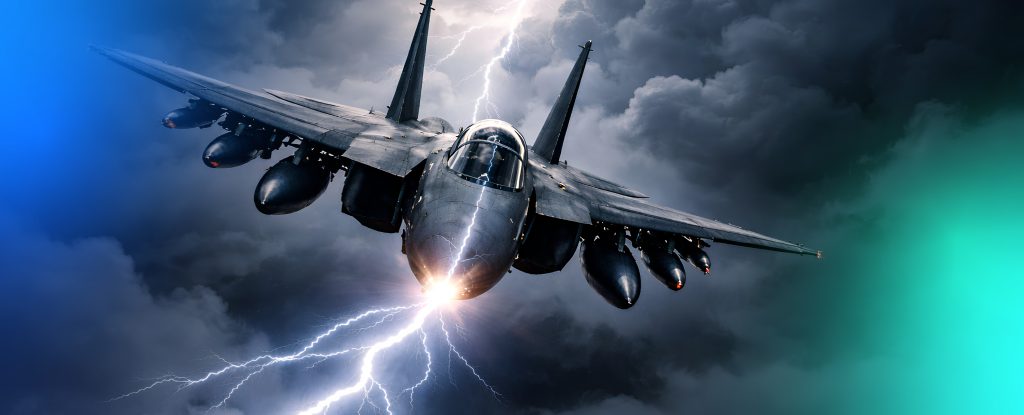
Military aircrafts are struck by lightning on average 10.5 strikes with an estimated occurrence every 10,000 flying hours in Europe. While lightning strikes are common, aircraft are designed with extensive lightning strike protection to safely conduct the high currents and electromagnetic fields and protect critical systems and pilot. Full-scale physical lightning testing is costly and can delay design corrections, while scaled models often fail to replicate full-size responses accurately. Virtual testing through advanced electromagnetic and multiphysics simulation enables engineers to study lightning effects on aircraft structure and cables efficiently, optimizing protection strategies without extensive physical prototypes.
Ansys EMC Plus can comprehensively evaluate electromagnetic behaviour on complex platforms when analyzing lightning effects on aircraft, including radiated coupling to cables, radiated emissions from cables, and coupling through shields, as well as EMI crosstalk between adjacent harnesses. The tool also supports studies of coupling from static discharges and high-intensity radiated fields (HIRF) into cables and equipment interfaces, enabling engineers to assess both cable signal integrity and lightning-induced transients at critical system ports in a single, integrated workflow [1].
Lightning effects on aircraft are generally divided into two primary categories. Direct effects refer to the physical damage caused at the lightning attachment point. In contrast, indirect effects arise from the electromagnetic coupling of the lightning current with onboard systems and wiring, producing transient disturbances that can interfere with or degrade the performance of electronic and electrical components. Lightning can also cause several critical hazards that affect various aspects of an aircraft’s operation and safety. It can lead to structural damage by creating punctures or burns in the airframe, compromising its physical integrity. Fuel system hazards arise if lightning ignites fuel tanks, increasing the risk of fire or explosion. Crew incapacitation is also a concern if lightning interferes with cockpit instruments or causes electrical shocks. Engine failure can result from lightning strikes damaging engine components or causing control system malfunctions. Additionally, thermal damage from the intense heat generated by lightning can weaken materials and critical systems, further endangering the aircraft. Aircraft manufacturers conduct extensive lightning strike simulations using tools like Ansys EMC Plus prior to production to mitigate risks from downward negative lightning.
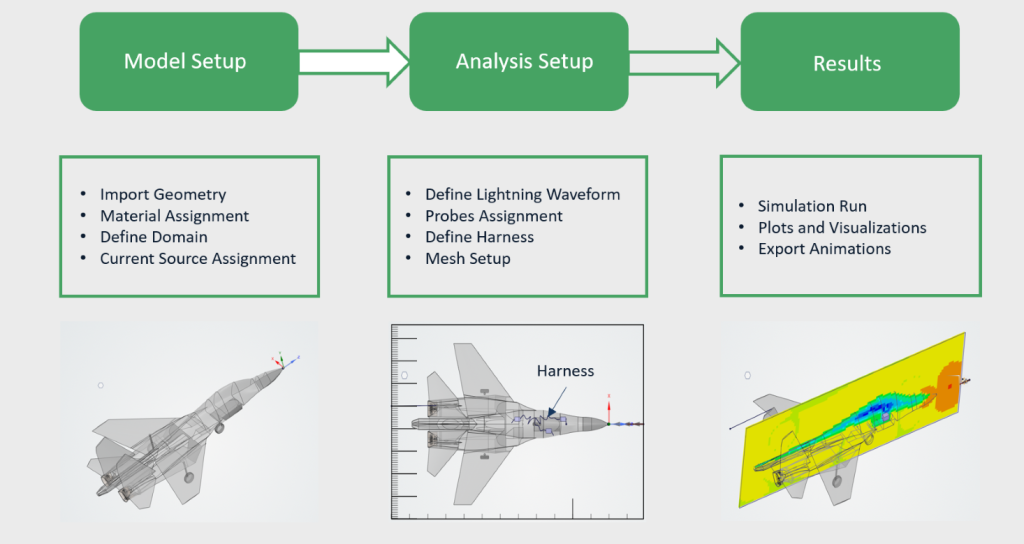
In accordance with SAE ARP5414, the aircraft structure is divided into lightning strike zones that classify the severity and type of lightning attachment expected at various locations. The aircraft nose is designated as Zone 1, which represents a primary attachment zone where lightning is most likely to strike and where the initial high-amplitude current waveform is expected to enter the aircraft. A lightning flash enters an aircraft at one point and exits at another. For simulation in this article the standardized current waveform is injected at the aircraft nose. This approach enables a realistic evaluation of indirect lightning effects on aircraft wiring, supporting compliance with industry standards and ensuring the robustness of system designs against lightning-induced disturbances.
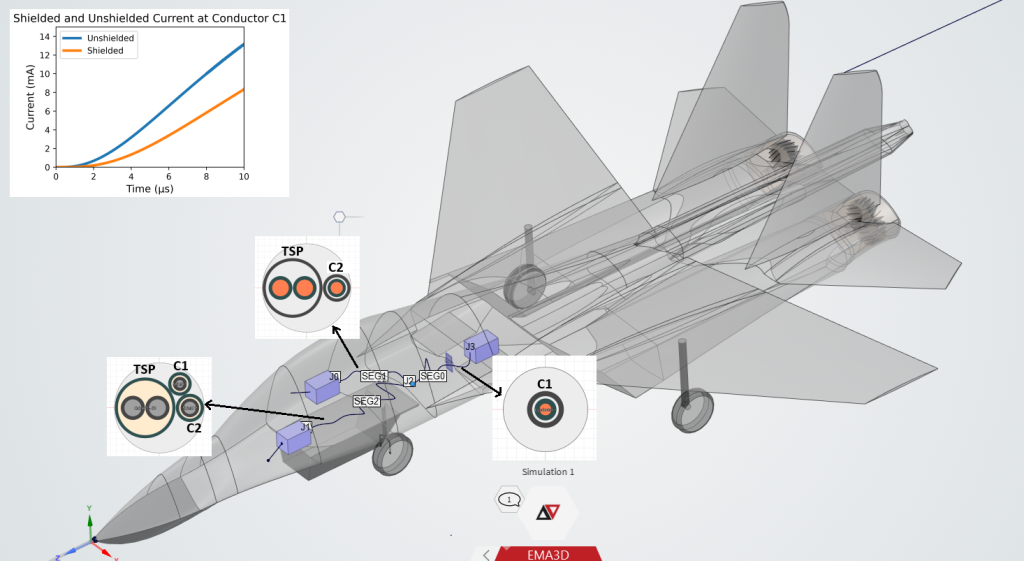
EMC Plus delivers advanced lightning probability simulation capabilities for mission-critical applications through seamless integration with Ansys STK. This approach goes beyond traditional Lightning Attachment Simulation and Aircraft Lightning Zoning Analysis by evaluating lightning strike probability along the complete aircraft mission profile. The automated Lightning Probability workflow enables users to run a full simulation with a single click, significantly streamlining the analysis process. By computing lightning strike probability along an aircraft’s trajectory for specific missions, the solution provides actionable insights to support effective risk mitigation and mission planning.